Digital Experience Lab

What is DxL?

The Digital Experience Lab (DxL) is aimed at exploring how artificial intelligence can be deployed to reduce cost, improve service and enhance the UBC experience.

UBC's Office of the CIO (OCIO) has established a DxL to help bridge the gap between ideation and operationalization. The mandate for DxL is to help the organization safely experiment with artificial intelligence (AI) by carrying out proof of concepts and creating minimum viable products for scaling up.

DxL focuses on providing AI solutions in the administrative areas of UBC that lay the foundation for achieving operational excellence and efficiencies while enhancing user experience for the services provided by the institutional units.

Why a Digital Experience Lab? 

DxL, in collaboration with key stakeholders and leaders at UBC, is helping to: 

  • Provide a safe ground to shape the AI solution roadmap for optimization and transformation of administrative functions using AI technologies 
  • Enhance decision-making processes for campus administration through AI modeling and solutions 
  • Explore opportunities and risks of adopting AI solutions
  • Gain valuable insights for AI solutions in a fail-safe environment with the intention to scale up
  • Build AI competency within the IT organization and expand AI skills


Approach for AI Solutions
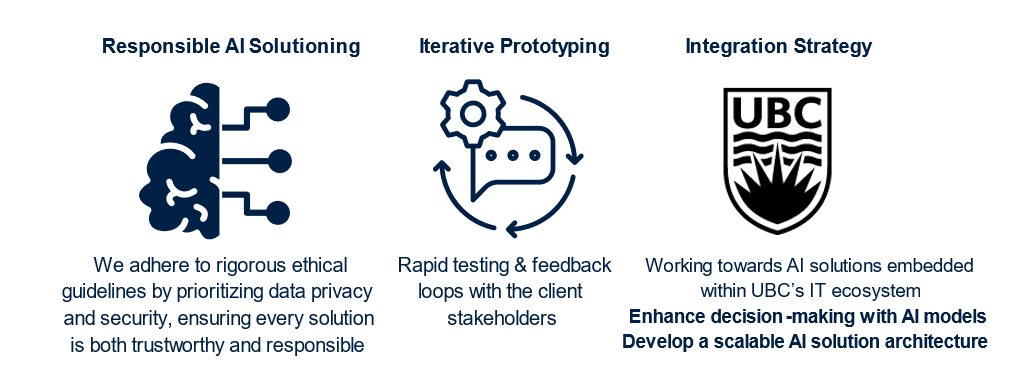
Our Principles for AI Solution Delivery

Deliver Proof of Value
Our Al solutions are designed to demonstrate tangible benefits with minimal investment. We prioritize a clear return on investment and focus on solutions that deliver immediate impact.

Responsible Al Solutioning Practices
We adhere to rigorous ethical guidelines and responsible Al principles. Our solutions are developed with data privacy and security in mind, ensuring a trustworthy and responsible deployment.

The DxL Team

In addition to the core development team, the DxL team includes advisors at the university including members from Legal Counsel and UBC IT (Enterprise Architecture, Data Governance, Client Service Managers, and Change Management).

Services

Chatbot development

Use Generative AI to develop chatbot assistants with the goal to help users access ready-to-use, relevant information.

Learn More

Data for AI Solutions

Use AI to manage, monitor, and steward APIs for secure, high-quality data access, ensuring data cleanliness, consistency, and reliability across UBC.

Learn More

Large Language Model (LLM) Services

Provide access to local LLM that aids for data analytics and efficient decision making.

Learn More

Page last updated on November 10, 2025


Urgent Message An exclamation mark in a speech bubble. Bluesky The logo for the Bluesky social media service. Bookmark A bookmark in a book. Browser A web browser window. Caret An arrowhead indicating direction. Arrow An arrow indicating direction. Arrow in Circle An arrow indicating direction. Arrow in Circle An arrow indicating direction. Time A clock. Chats Two speech clouds. E-commerce Cart A shopping cart. Facebook The logo for the Facebook social media service. Help A question mark in a circle. Home A house in silhouette. Information The letter 'i' in a circle. Instagram The logo for the Instagram social media service. Linkedin The logo for the LinkedIn social media service. Location Pin A map location pin. Locked A locked padlock. Mail An envelope. Menu Three horizontal lines indicating a menu. Minus A minus sign. Pencil A pencil indicating that this is editable. Telephone An antique telephone. Play A media play button. Plus A plus symbol indicating more or the ability to add. Print A printer pushing out a piece of paper. Search A magnifying glass. Settings A single gear. Arrow indicating share action A directional arrow. Speech Bubble A speech bubble. Star An outline of a star. Twitter / X The logo for the X (aka, Twitter) social media service. User A silhouette of a person. Vimeo The logo for the Vimeo video sharing service. Youtube The logo for the YouTube video sharing service.